Summer is generous with memories and stingy with your skin barrier. If you are looking in the mirror right now at a face that is somehow oily and flaky at the same time, with freckles that have joined hands into something less charming, you are not imagining it. This is what the end of August looks like on skin, and post-summer skin repair is exactly what fixes it.
I go through this every year. Not because I skip sunscreen, but because heat, chlorine, salt water, air conditioning and long days outdoors add up. The good news is that late summer is the single best moment in the calendar for post-summer skin repair, because the strongest UV is behind you and you have a clear runway before winter.
So let’s do it properly. Below is the reset I use: what actually happened to your skin, the order to fix it in, and the products worth spending on. No thirty-step routine. Six steps, four weeks.
What a Summer Actually Does to Your Skin
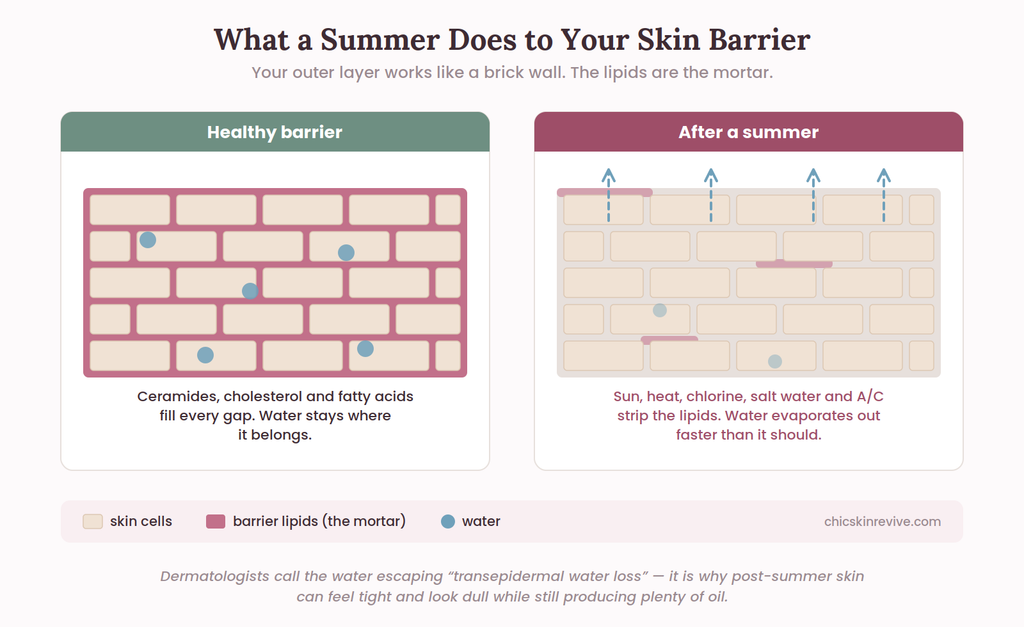
Three things happen, and they happen on different timelines. Understanding that is what stops you from panicking and over-treating in week one.
1. Your barrier gets leaky
Your skin’s outermost layer holds moisture in using a mortar of lipids — mainly ceramides, cholesterol and fatty acids. Sun, heat, chlorinated pools, salt water and air conditioning all deplete that mortar. When it thins, water evaporates out faster than it should. Dermatologists call this transepidermal water loss, and it is why post-summer skin can feel tight and look dull while still producing plenty of oil. Your skin isn’t confused. It’s dehydrated and compensating.
2. Pigment shows up late
This is the one that catches people out. The freckling and patchiness you are seeing now is partly a response to sun you got weeks ago. Sun-induced spots settle on chronically exposed areas — the face, the backs of the hands, the lower legs — and can also follow a sunburn to the shoulders, according to DermNet. They are stubborn. The American Academy of Dermatology notes that a spot only a few shades darker than your natural tone will usually fade within six to twelve months with treatment, while pigment sitting deeper in the skin can take years.
I say that not to discourage you but to reset your expectations. Nothing you buy in September is clearing summer pigment by October. Consistency is the whole game here, and my guide on how to get an even skin tone goes into the longer strategy.
3. Your oil production is about to change
As humidity drops, the routine that kept you matte in July will start to feel stripping in October. This is the moment to lighten your actives and richen your moisturizer — not the other way around, which is the instinct most of us have when we see congestion.
The One Rule: Repair Before You Renovate
Here is the mistake I made for years. I would come out of summer, see the damage, and immediately reach for the strongest thing in the cabinet — an acid toner, a scrub, a retinol I had abandoned in June. My skin would flare within days, and I would blame the product.
The order matters, and it is the part most post-summer skin repair routines get wrong. A compromised barrier cannot tolerate actives, and actives applied to a compromised barrier make it worse. So you spend the first two weeks rebuilding, and only then start correcting. If your skin is currently peeling, stinging when you apply anything, or reacting to products it used to love, that is your barrier asking for two quiet weeks. Give them to it.
Step 1: Downgrade Your Cleanser First
Before you add a single serum, subtract. Foaming, high-pH, “squeaky clean” cleansers are the most common reason a barrier never recovers. Switch to a cream, milk or gentle gel cleanser, use lukewarm water rather than hot, and stop washing your face twice a day if your skin is tight — one thorough evening cleanse plus a water rinse in the morning is enough for most people through a repair phase.
If you prefer plant-based formulas, several of the picks in my roundup of the best vegan facial cleansers are gentle enough for this stage.
Step 2: Rebuild the Barrier With Lipids, Not Just Water
Hyaluronic acid gets all the attention, but a humectant only pulls water in. If the mortar is missing, that water leaves again. What you need alongside it are the lipids themselves.
There is decent evidence for this. In a study published in Clinical, Cosmetic and Investigational Dermatology, a cream formulated with ceramides, cholesterol and linoleic acid in a 3:1:1 ratio — meant to mimic the skin’s own lipid profile — reduced transepidermal water loss by roughly 25% within two hours of a single application, and held that reduction across a full 24 hours. That was one specific formulation rather than every ceramide cream on the shelf, but the principle holds: replacing the lipid mixture works better than adding water alone.
The AAD also recommends applying moisturizer within five minutes of showering or bathing, while skin is still damp. It is a free upgrade and it makes a real difference.
For choosing a formula, my roundup of the top 10 best moisturizers for face covers most skin types, and if you are over forty and finding everything suddenly insufficient, the moisturizers for mature skin list is the better starting point.
Step 3: Add an Antioxidant in the Morning
Once your skin is comfortable again — usually around week two — start a morning antioxidant. Vitamin C is the workhorse, and the AAD lists it among the over-the-counter ingredients worth using for dark spots, alongside azelaic acid, glycolic acid, kojic acid and retinoids.
Two practical notes. First, vitamin C is temperamental: buy small bottles, keep them out of sunlight, and replace them when the liquid turns dark amber. Second, it is not a replacement for sunscreen. It works underneath one.
Step 4: Bring Pigment Treatment In Slowly
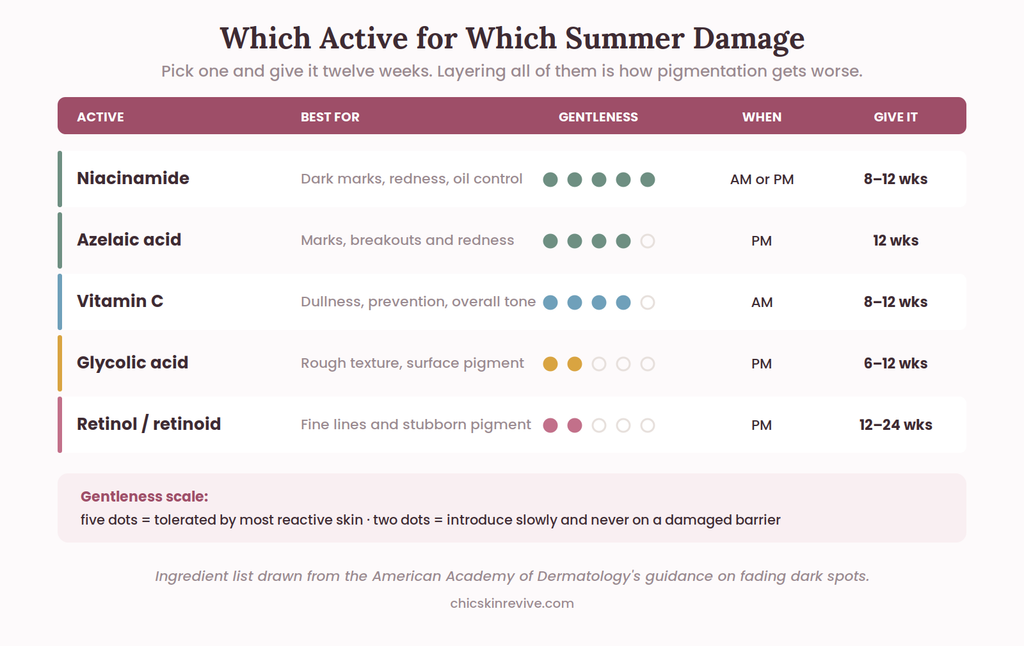
Pick one pigment-fading active. Not three. Layering vitamin C, an acid, niacinamide and a retinoid in the same week is how people end up with worse pigmentation than they started with, because inflammation itself triggers more pigment.
Niacinamide and azelaic acid are the gentlest entry points and are usually tolerated even by reactive skin. Glycolic acid is effective but demands strict sun protection afterwards. Whichever you choose, give it twelve weeks before you judge it.
And if summer left you with breakouts as well as spots — sweat, sunscreen and heat are a reliable combination for congestion — treat the acne first, because clearing post-inflammatory marks while new ones keep forming is a losing battle. My guide to dermatologist-recommended products for acne covers that side of it.
Step 5: Reintroduce Retinol — This Is the Window
Fall is retinoid season, and the reason is simple: you are heading into months of weaker UV, which is when photosensitising actives are easiest to tolerate.
The evidence here is genuinely strong. A 2025 systematic review and meta-analysis in Dermatology Practical & Conceptual pooled eight randomised controlled trials covering 1,361 patients and found topical tretinoin produced statistically significant improvements in both fine and coarse facial wrinkles from photodamage compared with vehicle, with the authors concluding it is safe and effective for this use.
One honest caveat: tretinoin is prescription-strength in most countries. Over-the-counter retinol is a weaker cousin and works more slowly, though it works. If you have never used one, start at the lowest strength, twice a week, applied to dry skin, with moisturizer over the top. Increase only when two weeks pass without flaking. My guide to youthful skin products and radiant skin care has more on building around a retinoid.
Do not start a retinoid on peeling or sunburned skin. Wait it out.
Step 6: Do Not Retire Your Sunscreen
Every September, sunscreen quietly disappears from bathroom shelves. It is the single most expensive mistake in this whole article, because everything in steps three, four and five is undone without it.
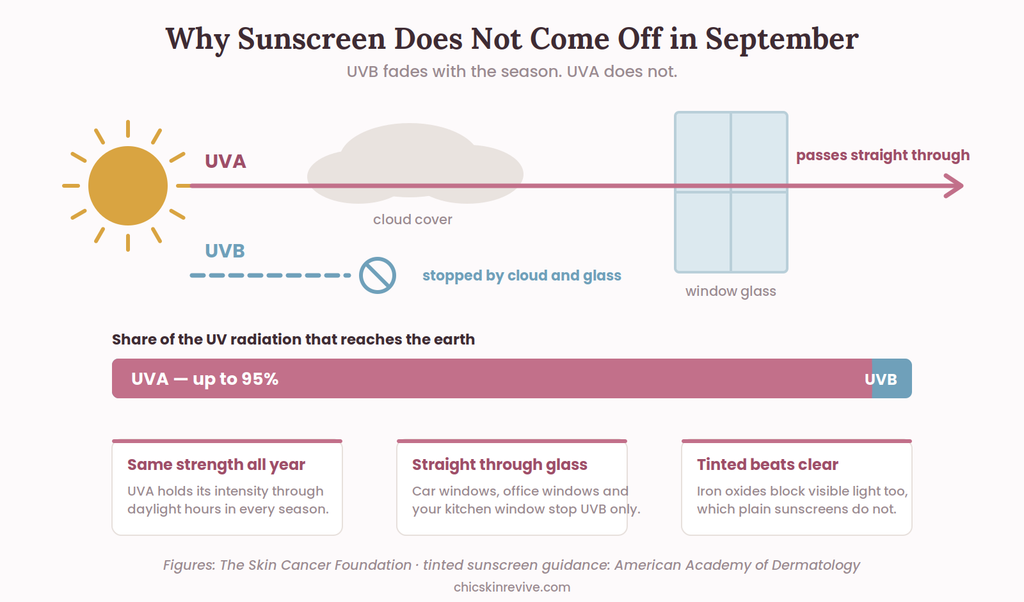
The Skin Cancer Foundation is blunt about why. UVA accounts for up to 95% of the UV radiation reaching the earth, it penetrates both cloud cover and window glass, and — unlike UVB, which peaks seasonally — UVA maintains the same strength during daylight hours throughout the year. The sun feeling weaker is not the same as the sun being weaker.
Two upgrades for a repair phase. Use broad-spectrum SPF 30 or higher with water resistance, as the AAD recommends. And if you are actively treating dark spots, the AAD specifically advises a tinted sunscreen containing iron oxide, because iron oxides help block visible light, which plain sunscreens do not — and visible light drives pigmentation, particularly in deeper skin tones.
Worth knowing: DermNet points out that clothing is more successful at preventing new sun-induced spots than sunscreen is. A hat is not a fashion statement, it is a treatment.
If sunscreen has always irritated you, my roundup of the best sunscreen for sensitive skin is where I would start.
Your Four-Week Post-Summer Skin Repair Schedule
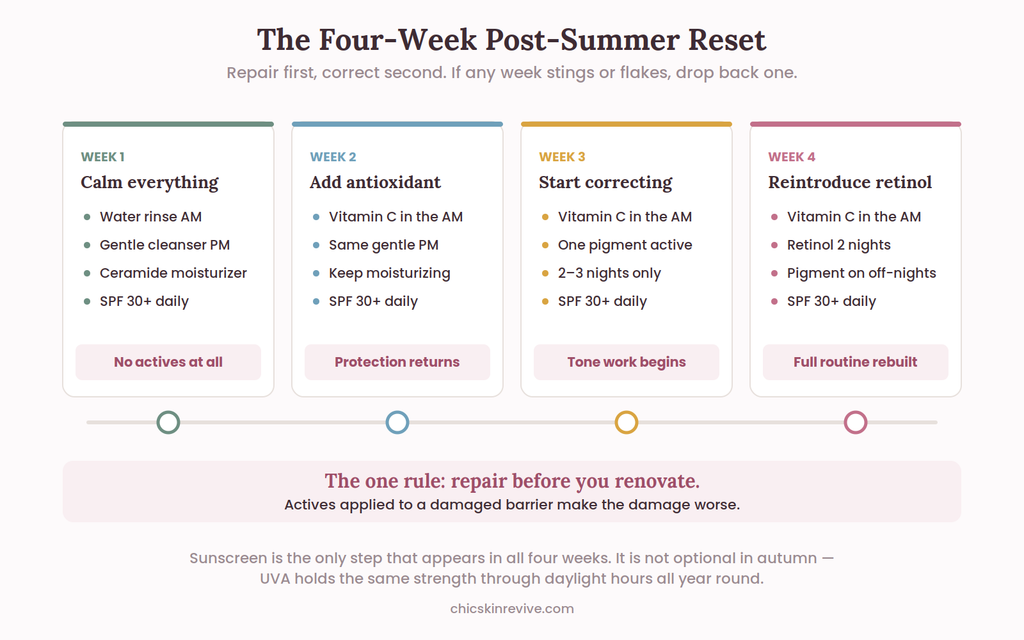
| Week | Morning | Evening | Goal |
|---|---|---|---|
| 1 | Water rinse, moisturizer, SPF 30+ | Gentle cleanser, ceramide moisturizer | Calm everything. No actives at all. |
| 2 | Add vitamin C before moisturizer | Same as week 1 | Antioxidant protection returns. |
| 3 | Cleanse, vitamin C, moisturizer, SPF | Add pigment active 2–3 nights | Start correcting tone. |
| 4 | Same as week 3 | Add retinol 2 nights (alternate) | Full routine, gently rebuilt. |
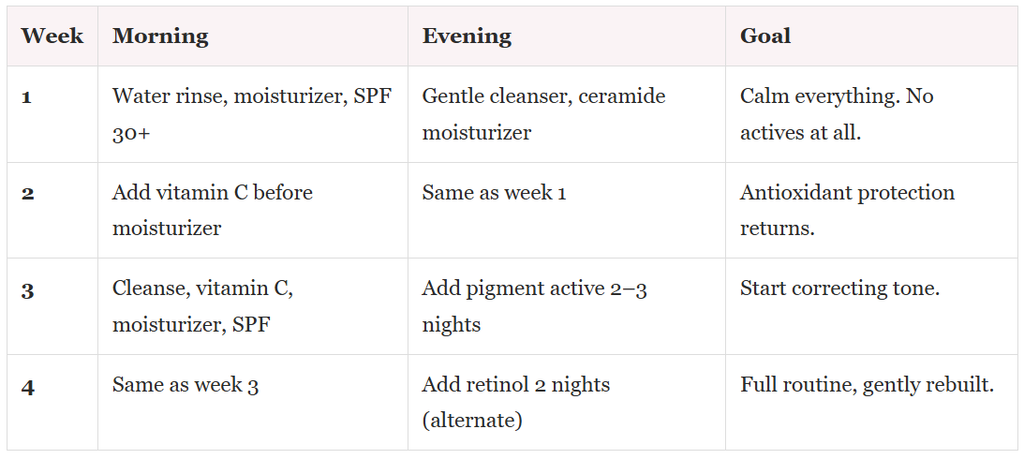
If any week brings stinging, redness or flaking, drop back one week. There is no prize for finishing on schedule.
My Product Picks for Post-Summer Skin Repair
These are the products I reach for at this point in the year, grouped by the step they belong to. You do not need all of them — one per step is a complete post-summer skin repair routine.
For rebuilding the barrier
CeraVe Moisturizing Cream — the reason this one keeps earning its place is that it contains ceramides alongside cholesterol and fatty acids rather than ceramides alone, which is the combination the research above points to. Fragrance-free, thick, unglamorous, effective.
La Roche-Posay Toleriane Double Repair Face Moisturizer — lighter than the CeraVe and a better fit if you are oily or live somewhere humid. Ceramide-3 and niacinamide, no fragrance.
For cleansing without stripping
La Roche-Posay Toleriane Hydrating Gentle Cleanser — creamy, non-foaming and forgiving. This is my week-one cleanser every year without fail.
For antioxidant protection
La Roche-Posay Pure Vitamin C10 Serum — 10% pure vitamin C in an opaque pump, which matters more than most people realise for a product this unstable.
For fading summer pigment
The Ordinary Niacinamide 10% + Zinc 1% — the low-cost way to test whether niacinamide suits you. If 10% feels like too much, and it does for some people, look for a 4–5% formula instead.
Naturium Azelaic Topical Acid 10% — my pick if your summer damage came with redness or breakouts as well as dark marks, since azelaic acid addresses all three.
For the retinol reintroduction
CeraVe Resurfacing Retinol Serum — an encapsulated retinol buffered with ceramides and niacinamide, which is exactly what you want when your barrier is only a few weeks out of repair.
Differin Adapalene Gel 0.1% — a genuine retinoid available over the counter, and the AAD includes adapalene in its list of retinoids for dark spots. Stronger than retinol, so introduce it slowly.
For daily sun protection
EltaMD UV Elements Tinted Mineral Sunscreen SPF 46 — tinted with iron oxides, which is the specific feature the AAD asks for when you are treating pigmentation.
La Roche-Posay Anthelios Mineral Tinted Sunscreen SPF 50 — the same idea at a higher SPF, with a universal tint that suits a reasonably wide range of skin tones.
The small extras
Aquaphor Healing Ointment — for the patches that are genuinely raw. A thin layer over moisturizer at night, on the areas that need it, not the whole face.
Aquaphor Lip Repair — lips take a beating over summer and almost nobody treats them. If you want to go further, my piece on vegan lip care ingredients covers the plant-based options.
Four Things Not to Do Right Now
Do not scrub peeling skin. Physical exfoliation on skin that is already shedding will tear at the fragile layer underneath, and can leave marks that outlast the tan.
Do not book an aggressive peel in week one. Professional treatments are excellent for sun damage, but on a compromised barrier they carry a real risk of post-inflammatory pigmentation. Repair first, then book.
Do not chase spots with everything at once. Pigment responds to consistency, not intensity. One active, twelve weeks.
Do not stop when it looks better. The improvement is the routine working, not the routine finishing. This is the single most common reason people repeat the same repair every September.
When to See a Dermatologist Instead
Skincare is not the answer to everything. Book an appointment if a spot is new and changing, has irregular borders or more than one colour, is itching or bleeding, or simply looks different from every other mark on your skin. The same goes for pigmentation that darkens rather than fades over several months, or a barrier that will not settle after a month of gentle care. These are quick appointments and worth the peace of mind.
Final Thoughts
Post-summer skin is not a failure. It is what skin looks like after a season of being lived in. The work is not dramatic — a softer cleanser, a better moisturizer, one active at a time, and sunscreen you did not put away in the drawer.
Start your post-summer skin repair this week. By the time the weather properly turns, you will be four weeks ahead of it.
If your routine also needs to survive a flight or two before the year ends, my skincare for travel tips will keep the repair going on the road — and if summer left your skin oilier than usual, the best skincare routine for oily skin pairs well with everything above.
Sources
- American Academy of Dermatology. How to fade dark spots in darker skin tones.
- American Academy of Dermatology. 12 summer skin problems you can prevent.
- The Skin Cancer Foundation. UV Radiation & Your Skin.
- Spada F, Barnes TM, Greive KA. Skin hydration is significantly increased by a cream formulated to mimic the skin’s own natural moisturizing systems. Clinical, Cosmetic and Investigational Dermatology. 2018;11:491–497.
- DermNet. Lentigo: Causes, Features, and Treatment.
- Huang HY, Lee LTJ. Tretinoin for Photodamaged Facial Skin: Systematic Review and Meta-Analysis of Randomized Controlled Trials. Dermatology Practical & Conceptual. 2025;15(4).
Chic Skin Revive participates in affiliate programs including the Amazon Services LLC Associates Program. Purchases made through links on this page may earn me a small commission at no additional cost to you. This article is for general information and is not medical advice — please speak to a dermatologist about your individual skin.